Tuesday, December 20, 2011

SMART or NOT?

Yesterday evening (December 19), I attended a gathering of transportation, research, and government people at the Michigan League of the University of Michigan. The U of M and its sponsors are conducting a tremendous amount of research to transform transportation and accessibility around the world, and is putting it into place with excellent results in places like South Africa, Pakistan, India, and the Philippines.

But not in Michigan.

Although the state of Michigan supports research and assistance for others, it doesn't make use of it for its own benefit. Instead, politicians make decisions that ignore research findings supported by Ford Motor Company, ALCOA Foundation, and the Rockefeller Foundation, not to mention the citizens and tuition-payers of Michigan. In addition, Michigan politicians overrule Federally-mandated procedures designed to insure that community members and stakeholders have a voice in their own transportation decisions.

I'm speaking of SMART, the University of Michigan, and the United States Department of Transportation's own procedures for establishing transit systems. And I'm referring, of course, to last week's decision by three men to implement a transit system for the Detroit metropolitan area that bypasses all the resources provided for sound decision-making, and all the community stakeholders. (All links below)

The three men are Dave Bing, Mayor of Detroit; Rick Snyder, Governor of Michigan; and Ray LaHood, United States Secretary of Transportation. Their decision to replace a light rail system with rapid buses ignores the experience and research findings of those who truly know about public transportation options. The decision also overturns the multi-year information gathering process that citizens paid for, as the process went through several iterations of the painstaking Federal Transit Administration's requirements, designed to link the best engineering knowledge with the most cogent local interests.

Citizens, stake-holders, investors, and engineers all agreed: the best option for Detroit is to begin with light rail on Woodward in combination with better connecting bus service. In a post to this blog in July 12 of this year, I debunked criticisms of the process with detailed references to how the light rail decision was arrived at. Light rail is the Locally Preferred Alternative.

Yesterday's gathering at the University of Michigan was notable for who was there. It was even more notable for who was not there. Present: sponsors from Ford, Rockefeller, and ALCOA; interested citizens and advocates from Washtenaw County, Detroit, and Lansing; researchers from U of M and Michigan State; the CEO of the Ann Arbor Transportation Authority; the Chair of the Washtenaw County Board of Commissioners.

Absent: anyone from the U.S. Department of Transportation, Federal Transit Administration, the office of Governor Rick Snyder, the Michigan Department of Transportation, the office of Mayor Dave Bing, or the counties of Oakland or Macomb. In other words, nobody who needs information to make sound transportation decisions was there.

I'm really glad people in Cape Town, Chennai, and Manila are benefiting from research conducted by the University of Michigan. What a shame it doesn't benefit Michigan itself.

To learn more:

  • SMART, Sustainable Mobility & Accessibility Research & Transformation
  • Detroit Mayor Dave Bing's Op Ed in the Detroit Free Press, 2011-12-18
  • "Smearing Woodward Avenue Rail" in this blog post.

Wednesday, December 14, 2011

Detroit's Dilemma: Light Rail, Bus Rapid Transit, or Rapid Bus?


You may have heard that yesterday (Dec. 13, 2011) a decision was made to cancel Detroit's Woodward Avenue Light Rail project, and to substitute instead a "rapid bus" system that would serve four Detroit corridors.
In an interview with Fox 2 News (linked below), Detroit Mayor Dave Bing is quoted as saying, "I don't think we should concentrate all of our efforts on the Woodward light rail. I think we've got to look at this region and do what's best for the region." A Detroit News article, "Light rail backers push Woodward line as bus system proposed", outlines the details and includes interviews with people who back the light rail system.
Does this mean the light rail plan is history? Another ambitious plan for Detroit that falls into oblivion? Possibly. Moneyed backers of the light rail system are reluctant to give it up, so some semblance of the proposed system may yet be built.Either way, now is a good time to look more closely at rapid bus in comparison with light rail. When transportation nerds hear "rapid bus", we think "Bus Rapid Transit" (BRT). But I'm not at all convinced that the Detroit plan will actually involve BRT - at least, not at first.
You see, some statements made by Gov. Snyder and his spokespeople a couple of months ago about the low cost of rapid bus, when Snyder announced his plan for Detroit transit, lead me to believe either of two possibilities: they may not understand what is really involved in"Bus Rapid Transit", or they may have used the term "rapid bus"because they envision something simpler and less expensive.
Here's a little table outlining the similarities and differences between Light Rail, true Bus Rapid Transit, and rapid buses:
Light Rail Bus Rapid Transit Rapid Buses
Runs on Rails in separate lanes Asphalt or concrete in separate lanes Asphalt or concrete in normal traffic lanes, possibly on a freeway at times
In traffic Usually has the right of wayUsually has the right of wayRuns with traffic, but may have special signals at some intersections
Stop spacing 1-2 per mile 1-2 per mile 2-3 per mile
Getting on Station or special platform Station or special platformsBus shelter
Paying Buy ticket before boarding Buy ticket before boarding Pay on the bus
Initial average cost per mile $34.8 million $13.5 million Much less, but not documented
Operating cost Low Moderate Moderate
Potential for development High Moderate Low
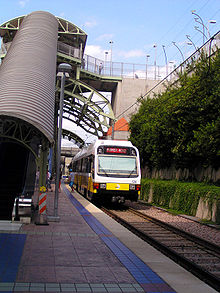
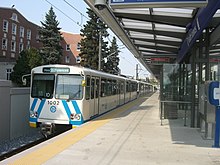
Light rail is a well-established transit mode that runs on rails, usually on its ownright-of-way. The Detroit plan called for mixing with traffic in the downtown area to give better access to local businesses. Over most of the line, stations were located about a half-mile apart, though the downtown area had closer spacing. Compared with buses, light rail is relatively inexpensive to operate. Each 120-foot train holds about three times as many passengers as the 60-foot buses normally used for BRT; each train and bus is operated by one driver, and since personnel is typically the largest cost, running BRT buses costs roughly three times as much as running a light rail train. Also less expensive is the energy for moving them: electricity for the trains,versus diesel or natural gas for the buses. However, to those low costs we must add the cost of maintaining the track and electric wires, while normally only the pavement would be a factor for the buses.
Bus Rapid Transit in its pure form is designed to work like a light rail train on rubber tires. It has its own right of way, similar station spacing, and people board at stations after paying their fare. The station platform is level with the floor of the bus, so people, strollers,and wheel chairs can roll on and off without having to lower the bus,deploy a ramp, or slow the boarding process in any way. When crossing streets, the approach of a bus changes the signal so the bus can proceed without stopping. Everything is designed to move people as efficiently as possible. But as you can imagine, dedicating a lane to nothing but buses, building stations, and purchasing large,specialized buses makes BRT pretty expensive compared with other kinds of bus service.
Rapid (or Express) bus is primarily a way of using ordinary buses on existing streets or freeways to speed up service at a minimum of cost. The buses stop less frequently than local buses, and in some cases have devices that give them some amount of precedence at intersections. Rapid bus routes are inexpensive to set up, since they don't necessarily need special stations, equipment, or lanes. But they sacrifice many of the advantages of either light rail or BRT systems: they are slower and less comfortable, because they stop and start much more frequently. Boarding is slower if fares are collected by the driver as passengers get on.

Los Angeles provides good examples of all three of these transit modes (see links below). The Blue, Green, and Gold line are light rail; the Orange Line is BRT,and there are 26 rapid bus routes in addition to multiple local bus lines. (The Red and Purple lines are what's known as "heavy-rail"subways.) I've ridden the Blue, Green, Gold, Red, and Orange lines,but not the rapid buses. The Orange Line runs from North Hollywood to Canoga, part of the way in the wide median of Chandler Boulevard, the rest of the way on the old right of way of Southern Pacific Railroad's Burbank Branch; it is being extended to Chatsworth. I rode it in October of 2007 in mid and late afternoon, and found the bus a little bumpy and jerky, but well patronized. (The buses are equipped with TVs, but what do you expect in Hollywood?) During rush hours,the BRT system now operates at capacity due to high ridership, and the LA transit authority is experimenting with ways to increase capacity, such as using longer buses or running buses in "fleets"of two or three.
The LA Transit "Metro Rapid" and similar area services use articulated buses, for the most part,similar to those on the Orange Line (but painted different colors). They stop at bus shelters (not stations) and are built with low floors to make boarding more rapid. Some of the bus shelters are equipped with "next bus arrival" signs. In the City of Los Angeles, traffic signals along their route recognize the buses' presence and change to let them through, but outside the city many of the signals aren't equipped to recognize them, and don't give them precedence. Their speed and passenger-carrying capacity is less than that of light rail or the Orange Line BRT, but greater than that of the local buses.
Development incentive is probably the the most important difference for a metropolitan region choosing between light rail, BRT, and rapid bus systems. Light rail systems built recently in several U.S. cities have spurred tremendous investment in developments around the stations. Four to eight dollars of private investment is widely reported for every dollar spent building light rail. Most observers agree that rails in the ground give developers confidence that the service will be around for the long term, and that lots of people will be riding.
BRT figures aren't so easy to come by in this country. The systems I've looked at personally (Los Angeles and Cleveland) don't appear to have attracted much development that wouldn't have happened anyway. However, Enrique Peñalosa,who spearheaded the BRT system in Bogotá, Colombia, points to tremendous development near the BRT corridors of his city. Bogotáhas no other rapid transit in competition with BRT, whereas both LA and Cleveland have rail transportation options, which experience shows to attract development quite reliably.
There is no evidence that I know of to indicate that rapid or express buses stimulate development. Because they have so little fixed infrastructure, there is no assurance for developers that their investment would be safe.
Perhaps in Detroit, with few rapid transit options other than BRT, it would attract some of the development we've been looking for from a light rail system. We can hope - and push for - a true BRT system. But let's not give up on light rail: experience around the country shows light rail is really what attracts private investment to cities.

Sunday, November 20, 2011

Exalted, Unreasonable Hope

Do you know the exalted, unreasonable hope that wells up out of utter despair? That's what I tried to get at with this piece.
- Darol Anger, from the liner notes to "The Unbearable Gift", on his CD album Woodshop.

I've been following with great interest Vivienne Armentrout's blog, "Local in Ann Arbor" (all links below). Vivienne has a great eye for detail and a gift for putting the details all together in a lucid, enlightening essay.

But much as I admire her abilities, I almost always end up in disagreement with her. (So much for the idea that we can solve all our disagreements if we all agree on the facts.)

Vivienne has been doing a carefully-researched series titled, "AATA: Moving Us Where?", analyzing the emerging county-wide transit plan, "Moving You Forward". Her well-documented conclusion: we can't do it. We don't have the money, and there are far too many uncertainties in the political arena, not to mention the uncertainties of life in general.

That's why Darol Anger's thoughts (quoted above) struck me when I noticed them in a copy of Sing Out magazine this morning. I continue to hope, unreasonable though it may seem, that we'll be able to develop and support a county-wide transit system. Here are two ways to look at it: historically, and in terms of alternatives.

Historically

When have we ever achieved anything worth doing, without risk? Consider...

  • Would we be living in America if our ancestors hadn't taken the risk of coming here, not knowing whether they would make it in the "new world"? (Many, many of them died in the attempt.)
  • Would the United States be an independent nation if the Founding Fathers had waited until the budget permitted them to raise an army? (And the outcome was in grave doubt for many years.)
  • Would the Interstate Highway System have been built if it was known back in 1956 that the system would cost more than 1.2 trillion dollars...and practically none of that was identified in the budget?

Many factors led to people's decisions to go ahead with these efforts. One factor was an optimistic vision of the future, an "unreasonable hope", as Darol Anger put it, that they could make their lives better by working through the uncertainties.

Another factor was "utter despair" at the current situation, whether it was poverty and opression in the "old world", anger at being exploited by England, or frustrating snarls of congestion on two-lane roads. My feeling is that, if we're not in "utter despair" yet (and many Michiganders are), we will be soon.

One Alternative

What happens if we elect the "status quo" alternative, continuing as we have been? Certainly, one alternative is to do nothing. We could try to continue with AATA as it is, supported mainly by the millage paid by Ann Arbor residents, together with state and federal funding and relatively small "Provision of Service Agreement" funds from outlying areas.

As Vivienne has counted the cost of improvement, so too, we need to count the cost of doing nothing. I hope Vivienne will update and elaborate on the estimate I did two years ago in my blog entry, "Can we afford a county-wide transit system?" Using data from the Census Bureau, WATS, AAA, and APTA, I came up with these conclusions:

  • 112,980 households in Washtenaw County had 2 or more automobiles;
  • the annual cost of owning an auto at that time was $9,190 (it's closer to $10,000 now);
  • if only 20% of the multi-auto houseolds were able to reduce their vehicles by one because of improved transit, the total savings in the county would be $207,657,240 each year;
  • if residents kept 75% of that money and paid only 25% for transit, the county-wide savings for residents who sold one car would amount to $155,742,930 county-wide, and the transit agency would receive $51,914,310 in local funds;
  • each household would pay $386.88 in transit tax, and those that sold a second vehicle would gain $1,160.64, a 300% return on investment.

These figures are now two years old, and they don't take into account Michigan's local tax structure. It would be a great service for someone with a better understanding of the legal details to update and refine these numbers.

We also need to consider the "collateral damage" of leaving most of the county very auto-dependent: the loss of people who can no longer afford to live in such an expensive transportation environment, and the loss of creative young people who far prefer to live free from the many burdens placed on us by our automobiles.

So the ultimate question to answer is, Can we afford not to have a county-wide transit system?

To learn more:

Friday, October 28, 2011

Rick Snyder's New Way to Go


Wednesday, Michigan Gov. Rick Snyder introduced a new transportation funding proposal. Little by little, details are coming out.
First, here are the main parts of the proposal as they were delivered Wednesday:
  • Changing the way motor fuel is taxed from per-gallon paid at the pump by motorists, to a percentage of the price paid by wholesalers; the shift is to be "revenue neutral" when it kicks in, but will change as the price of oil fluctuates;
  • Adding an additional registration fee for license plates;
  • Allowing regions to add a further fee to license plates for regional transportation projects;
  • Creating a regional transportation authority for Southeast Michigan that includes the City of Detroit, and the counties of Wayne, Oakland, Macomb, and Washtenaw.
Today (Friday, Oct. 28) Dennis Schornack, Special Advisor to Gov. Snyder, added a number of details at a meeting of the special financial advisory group of the Ann Arbor Transportation Authority. (This is the blue-ribbon pannel assembled to propose funding methods for the Transit Master Plan.)
Remember that these are still proposals, and must be approved by the House and Senate, which will certainly have a lot to say about it...but here are some of the highlights:
  • The state-wide registration fee is to be based on the value of the vehicle, as the current fee is; it is advertized as "$10 per month", but that obviously adds up to $120 per year; that's said to be a maximum, so presumably people whose cars are worth less money would pay less than $120 for their registration;
  • Any county or contiguous group of counties can propose a license fee of up to $40 per year; (that's $13.3333 per month); the amount would need to be approved by the majority of voters in the proposed region, with no "opt-out" provision for sub-regions that don't think they want to participate; in our case, that means the votes of everybody in Macomb, Oakland, Washtenaw, and Wayne counties, including the City of Detroit, would be tallied together - not as individual counties, and if the majority of voters in one county voted against it while the majority of the region voted in favor, they would still be subject to the tax;
  • All the funds raised by either new fuel or new license fees would be subject to the Michigan constitutional requirement that 90% of all funds raised through vehicle and fuel taxes be allocated to roads and bridges, with a maximum of 10% going to transit;
  • Funds raised by a regional registration fee would be limited in where they can go: 95% would be directed to the county in which they are raised; in other words, for every $1,000,000 Washtenaw County raises, it would be guaranteed at least $950,000 for its internal use, but the other $50,000 could be spent in another part of the region at the discrition of the regional authority;
  • The Governor will recommend that the full 10% constitutionally allowable be used for transit, which is more than the amount currently allocated; using the example above, Washtenaw County would be able to use $100,000 for transit out of every $1,000,000 it raises through license fees;
  • The regional transit authority for Southeast Michigan would be responsible for four proposed transit routes: Gatiot Avenue, Woodward Avenue, M-59, and Michigan Avenue to Detroit Metro Airport and Ann Arbor;
  • Other public transit services in the area would be "contracted" to provide service, and would receive federal and state funds through the regional transit authority
  • The committee setting up the regional authority for Southeast Michigan is composed of Governor Snyder, Mayor Dave Bing, andx Federal Transit Administrator Peter Rogoff; these would continue to serve as titular heads of the authority once it is set up, though of course others would carry out the day-to-day administration.
So that's a lot of information, but it's all tentative. Remember the second Detroit River Bridge? The Governor proposes, the Legislature disposes. (But the Governor hasn't given up on the bridge yet...)
The information we have raises a lot of questions as well. Mr. Schornack, when questioned about some of them, smiled and said the Governor preferred to start with the "10,000-ft. view" and work out the details later. What questions do you have? We may be able to get at least a few answers from the Governor at Monday's Michigan Rail Summit.
Meanwhile, I'm off the the Midwest Highspeed Rail Association's Fall meeting in Cleveland. I started this blog on the AATA bus coming home from the meeting, and I'm now on the Megabus en route from Toledo to Cleveland. (I had to try the Megabus service to see how public transportation that claim to make a profit actually feels to the consumer. More later...)

Thursday, October 6, 2011

If you don't offer walkable urbanism, you can write off your future development


"If you don't offer walkable urbanism, you can write off your future development." - Christopher Leinberger

That was his answer when I asked about need for healthy development in the face Southeast Michigan's declining population and environment.

Leinberger, a Professor at the University of Michigan's Taubman School of Architecture and Urban Planning, and a Senior Fellow at the Brookings Institution in Washington, DC, was speaking at Concentrate's Speaker Series at The Ann Arbor Comedy Showcase. (No joke.)

After his talk, I pressed him further about Ypsilanti Township's situation - after all, that's where I live and where I'm a Planning Commissioner. He answered with a smile, "Ah, Ypsilanti! What a great town!" "But what about the Township," I insisted. "Focus, focus, focus on the downtown!"

Unable to monopolize the Great Man's attention further, I couldn't tell him that Ypsi Township doesn't have a downtown. But I can imagine his reply if I had. "Work with the City!" Can we actually work together, the City and the Township...?

I just read in today's Ypsilanti Courier that Paul Schreiber, the City of Ypsilanti's Mayor, addressed his City Council with a gloom-and-doom message last night. So bad is the financial outlook that not only could 65% of the City's general-fund employees be laid off, but those that remained would have their health insurance capped or cropped. The Township isn't much better off, with the work-week reduced to 30 hours and mandatory furlough days.
The City's Water Street project was to be a great example of what Leinberger praised tonight as a "near-downtown" center of walkable urbanism. Instead, it's a $1.3 million annual debt load on the City and it's citizens. We've got to find a way to turn it from a burden into a profitable, tax-paying development. The City and the Township need to work together for that, because without a financially healthy urban center, neither of the Ypsilantis will pull through this financial crisis. But we can't seem to work together, can we?

It was Ben Franklin who said, "If we don't all hang together, then surely, we shall all hang separately."

Looks like we're about to prove him right. The noose is tightening around Ypsilanti, both City and Township. Let's get together and at least plan our development strategy jointly, beginning with walkable urbanism, a focus on downtown, and and end to greenfield development in the Township.

More on this later...

Saturday, September 24, 2011

Q: Sustainable I understand, but why transit-oriented?

I've been re-thinking some of the basic issues Wake Up Washtenaw is here to address. Based on some of the questions I get when out talking with people, I'm going to "go back to the basics" with a series of FAQs (Frequently Asked Questions). Here's the first:

Q: Sustainable I understand, but why transit-oriented?

A: Transportation has determined how humans build communities since the rise of cities. Whether on rivers, harbors, or caravan routes, people living in fixed towns and villages want to be where they can take advantage of transportation routes. In the United States, it's especially important for us to be able to move freely, because the essence of freedom is being able to go where we want to go.When someone is arrested, the first freedom they lose is the ability go where they want.

During the second half of the 20th century, we Americans invested about 1.2 trillion dollars to build the Interstate Highway System, which enabled many of us - for a while - to live a long way from where we work, play, and get our food.  But now, we're paying the price: the result was sprawl, congestion, dependence on foreign oil, and forcing people either to invest heavily in personal transportation (cars), or be relegated to an under-class whose freedom to move around is very limited. Car-less people have relatively few choices of where to live in order to preserve their freedom of movement. That's why young people who prefer not to have a car migrate away from Michigan to live in cities like Chicago, Boston, Washington, Seattle, and San Francisco. And that's why being unable to own a car in Michigan is effectively a prison sentence.

Good, reliable transit provides everyone with a relatively inexpensive alternative way to get where they want to go...within limits. It doesn't go everywhere, and it never will. Transit will never replace personal vehicles for everyone, so it's important to have cars and trucks that don't burn petroleum products.


But strong, fixed transit does more than provide an alternative: it encourages communities to grow in compact clusters close to transit stations. Such communities enable people to obtain their daily needs within walking distance of where they live. It enables them to use transit to get to work on time. It makes it necessary to for them to walk a bit more, which improves their health. It eliminates the need to burn petroleum in order to get to a store for food. That, in turn, reduces our dependence on imported oil. (Americans send more money abroad to buy oil than we pay in taxes to maintain our roads.) And greenhouse gas emissions are reduced as well. Transportation is responsible for about 30% of America's greenhouse gas emissions.

So having communities that are oriented around good, fixed transit is an essential key to sustainability. There's a lot more we need to do, but without reshaping our communities away from sprawl, all other measures will fall very short of sustainability.

Thursday, September 15, 2011

What ever happened to profitable public transportation?


Back in the 19th century, lots of entrepreneurial companies set up public transportation services...mainly rail-based, both on streets and on their own right-of-way. And they made handsome profits.
We still have a few private transportation companies making a profit in the early 21st century, but very few: some airlines (not all!), and just possibly some inter-city bus companies. Megabus? Greyhound? I'm not sure. (Usually I like to check my facts, but today I want to spark comment and discussion, so bear with me...and put in your two-dollars worth! [Inflation.])
I think it's critical to get private business to invest in - and make a profit from - public transportation. Why? Because we need to ramp up our public transportation options pretty quickly to avoid peak-oil problems, and if the private sector could be offered a profit in making that happen, it could get done much sooner.
Today, I want to look at how public passenger transportation used to make money, how it still does in some places, and why it no longer does here in the US.

How did they do it?

In the 19th century, railroads were money-making operations for a number of reasons...
  • At first, roads were terrible and there was no other practical way to get around. (Contrary to what some people may think, Conestoga wagons were never  transportation of choice - only of necessity.)
  • In competition with canals, they were faster and less labor-intensive.
  • When other railroads arose in competition, they either provided needed capacity, or were bought out; we see this happening in the airline industry now.
  • In the west, the government granted lands to the railroads - more than they needed for themselves, but enough to sell as real estate to pay for the cost of their construction. Of course, this land had been stolen from the Native Americans...
  • Monopoly was standard procedure whenever possible; when a railroad was the only one serving a territory, it charged crushing rates, and employed any means possible, including violence, to maintain its monopoly; ask any California historian about the "soulless Southern Pacific".

Why can't we do it anymore?

Several reasons, some connected to abuses of the past...
  • No more stolen Native American lands to give away to the railways.
  • Heavily subsidized options: highways are almost 100% subsidized by taxpayers, and airways are to a large extent also, yet the fact that we have to subsidize public bus and rail service comes as an unwelcome surprise to many Americans.
  • In order to use automobiles on "free" (publicly subsidized) highways, we pay more to foreign countries in gasoline and diesel costs than we do to our own government for the highways.
  • Transportation companies are not allowed to diversify much, because of their history of monopolizing and bullying.

Where does public transit make a profit?

True, there aren't many places where it does...but there are some. Each merits a closer look than I can give it, but here's a quick outline.
  • Latin America, for sure Curitiba, Brazil; and Bogota, Colombia; maybe others too. The government of these two cities built the infrastructure for bus rapid transit (BRT) and loaned money to private operators to purchase appropriate BRT equipment. The operators repay their loans, pay taxes, fuel, drivers, etc., and make a profit beyond that. Labor and fuel costs are relatively low in Latin America, which clearly helps.
  • France with high-speed rail. The French TGVs run on track paid for with government money, but they make enough profit from high-speed service to subsidize normal-speed service operation throughout France.
  • Japan has many private companies that run passenger railways and make a profit. Whether the railways themselves make a profit is not always clear, because the companies are all diversified into retail, real-estate, entertainment, banking, hospitality, and so forth. In many cases, a company's railway and its other holdings operate synergistically. For example, Hankyu owns department stores built over some of its stations, and hotels nearby, each part of the business helping the other.

Now what?

What can we do here in the United States? Are our legal and financial structures too rigid to allow public ground transportation to make a profit ever again? If not, what do we need to change? What legal and financial structures can be modified to permit us to provide lots more public transportation, and fast? Share your ideas here!