Thursday, June 21, 2012

WALLY in Texas x 2


Yes, two very similar projects in Texas are a lot like WALLY, the Washtenaw-Livingston commuter rail projects.

Both the Texas projects head north from a larger city to a rural/suburban area, just as WALLY will. The two Texas lines are the Capital MetroRail, from downtown Austin to the northern suburb of Leander; and the Denton County Transit Authority's A-Train, from Carrollton (itself a northern suburb of Dallas) to Denton, a town even farther north. I've had the opportunity to talk to the people who spearheaded each of these rail lines, and over the past few days have ridden each line from end to end.

Capital MetroRail

I blogged about this line in 2009 (links below) before it opened for business. Austin to Leander service started in March of 2010 on 32 miles of existing freight railroad with improvements to allow higher speeds and avoid conflicts with freight traffic. Like WALLY, the rail line is actually owned by the government - in this case, by Austin's Capital Metro itself. And like the Michigan's state-owned rail lines, it was purchased in the 1980s (1986, to be exact) when the original railroad-owners put it up for abandonment.
The line serves nine stations, including some in Austin's urban area and others with large park-and-ride lots in suburbs.When service started in 2010, trains ran only in rush hour, but now 18 trains are run in each direction Monday-Thursday. Beginning this month (June 3), six more trains were added each way on Friday evening, plus Saturday service with 14 trip-pairs in the afternoon and evening, to allow riders access to Austin's sports, music, and entertainment. During the first year, ridership averaged 1800 daily, but overall ridership will probably go up now that extra trains are running.

I say "trains", but that may be a bit misleading. Capital Metro runs single, articulated Stadler GTW 2/6 rail diesel cars, with seats for 108 and standing room for 92 more - a total of 200 passengers. These are run in the street for a couple of blocks in downtown Austin, and on the shared track the rest of the way. Because they are built in Switzerland to European standards, they are not allowed to at the same time as freight trains, so the freights are allowed to run only when the Stadler cars aren't running. The Austin and Western Railroad, the short-line which runs the freights, is not apparently inconvenienced by that arrangement.

Among the improvements made before passenger service began: the line was leveled for higher-speed (I believe they run up to 79 MPH), and passing-tracks were built at several of the stations. Schedules are arranged so that northbound and southbound trains meet at these stations; there were no delays due to late trains when I rode on June 18, so the arrangement seems to work well.

What about transit-oriented development? There is some, but it's not coming as fast as former Leander Mayor John Cowman hoped. I didn't have a chance to talk to Mr. Cowman or look around as much as I would have liked, and I can't find any evidence that the Valence Technology plant (mentioned in the October 23 blog) was actually built.
I discussed the rail initiative with Mr. Cowman in October, 2009, at the Rail~Volution conference in Boston. You can read the summary in my October 31 entry (linked below). One thing that stood out: it took a tremendous amount of energy, "moxie", and political maneuvering to arrive at agreement to go forward with the rail initiative. It didn't just happen through the normal bureaucratic process!

I'll blog about the Denton County line next time...
To learn more:

Monday, June 11, 2012

Sustainable Lifestyle in the Black Forest


They worked hard, they lived sustainably, and they lived well.

Black Forest house built 1599.
(Freilichtmuseum Vogtsbaurerhof, Hausach, Germany)
That's my conclusion after getting acquainted with the pre-industrial lifestyle of the Black Forest region (Schwartzwald) of Southwestern Germany.

It was only a short visit (in space, not time!), but I was quite impressed. My cousin, Franzjörg Krieg, was born in 1948 in Rotenfels, a small town in the Black Forest. His father Heinrich was a Master Wagner (wagon-maker), and Franzjörg learned much of the craft as a boy in the old-fashioned, hands-on manner. And not just wagon-making, but the whole life-style that went with it: raising animals for food, growing fruit and vegetables, processing them for preservation, and making good food and drink from them. His Dad made great schnapps (trust me - and there's still some left!), but that was actually a normal part of life in the Black Forest - most families made a wide variety of tasty food and drink.

Farm wagon
(Freilichtmuseum Vogtsbaurerhof, Hausach, Germany)
The tools, the clothing, the animals, the machinery, and especially the houses - all are lovingly preserved in the Freilichtmuseum (Open Air Museum) at Hausach. It's a lot like Greenfield Village.

Perhaps the houses are the most impressive, because they were crafted for sustainability, efficiency, and comfort. The earliest one was built in 1599, and continued in active use through the mid-20th century - nearly four centuries. Completely made of local materials.
Storehouse and main building
(Freilichtmuseum Vogtsbaurerhof, Hausach, Germany)
The term "house" is misleading. These are more like compounds. Typically, they were three stories high, built on the side of a hill (there are plenty of hills in the Black Forest!) so that each story had a ground-floor entrance. Very practical when you have animals on the lowest floor, people on the second floor, and a combination storage-workshop on the third. The walls were build of thick, squared logs joined with mortar; roofs were of wooden shingles, often with thick straw thatch over the top. One of the houses at the museum had a double wall for insulation, with a passage-way between inner and outer walls that was used for storage. The climate in the Black Forest region is very similar to Michigan's, so winters can be quite bitter (or they could...).

Running water was provided by drilling out logs with a huge, hand-operated drill. This pipe, which was usually buried, ran from the nearest spring to a point near the kitchen (second floor), where it was used not only for drinking and washing, but also to keep milk and butter cool.
The kitchens were in the center of the second floor, so the heat from the stove would reach as many rooms as possible, but there was normally a big stove in the dining/living room, too. And the heat from the animals on the lowest floor would also rise to provide warmth to the floors above.

Speaking of animals, the manure - of course - was used as fertilizer. Even the human waste was used: the "toilet" was in a small room that protruded a little from the second floor, and the waste dropped into a barrel outside, near the place where the animal waste was channeled out of the barn.

Wood shingle + straw roof
(Freilichtmuseum Vogtsbaurerhof, Hausach, Germany)
Though there were a lot of conveniences - or at least efficiencies - there was still a lot of work to be done. Animals need care, gardens need cultivation, fields of wheat, barley, other grains need plowing, harvesting and threshing. And though we might consider this "low-tech" living, there was actually a lot of specialized technology that needed "technicians" to produce as well as maintenance at the farmhouse. Working with animal hides to create shoes, leather aprons, harness for the draft animals - this was often done by specialists (tanners), but was also done "at home" on many farms. Iron tools, of course, were the province of the smith, but when they broke on the farm, they were usually repaired on the farm. Even straw (the stalk of a grain crop that doesn't provide nourishment for animals) was used: the bulk of it for roofing (and re-roofing), but slippers and other articles were also made from braided straw.
Golden slipper from straw
(Freilichtmuseum Vogtsbaurerhof, Hausach, Germany)

Clothing was made of wool sheared from the farm's sheep, carded, spun, knit and woven in the house. Flax was another source of fiber for clothing. Of course, there were rough work clothes, but there were also fancy clothes for special occasions. Sunday was always a day for church and rest; most Black Forest residents were observant Roman Catholics.
In her Sunday best
(Freilichtmuseum Vogtsbaurerhof, Hausach, Germany)
Always, there was something that needed to be done. Like any farm life, it was hard work. But these farmers lived well: they had warm clothes, sturdy warm houses, plenty of variety in their diet cooked into savory dishes, and a wide variety of strong drink with which to relax after a hard day.

Not a bad life...and it was sustained for many centuries. Perhaps we could learn a thing or two about sustainability from them.
To learn more:
  • Schwarzwälder Freilichtmuseum Vogtsbauernhof (Black Forest Open Air Manor Museum) - English - German
  • The Wagon-Maker, a site dedicated to the Krieg wagon-making shop in Rotenfels, illustrates one particular "medium-tech" craft.

Tuesday, June 5, 2012

Regionalism and Transportation-alism?


Four important things happened yesterday, or were announced:

  1. Michael Ford announced that Washtenaw County has been removed from the proposed southeast Michigan RTA;
  2. Ann Arbor appeared on the front page of USA Today as having the fourth-fasted growing transit ridership in the country;
  3. Ann Arbor city council approved a revised agreement for county-wide transit, sending the plan further along the runway;
  4. And AA council also approved moving forward with a study for a new rail station.
I'll take a break from my blog series on Germany to look at these important items. Details follow...

Washtenaw out of RTA?

At last night's u196 Board meeting, Michael Ford, AATA's CEO, announced that Washtenaw County had been removed from consideration as part of southeast Michigan's Regional Transportation Authority (RTA). I have not been able to verify this on the Michigan Senate's Web site, so I assume it was an understanding reached at the Mackinac Policy Conference last week.
Jesse Bernstein, AATA's Board Chair, expressed relief. Though just five days earlier, in an interview with Ann Arbor.com (linked below), he had stated a willingness to work with Detroit area transit, his relief was expressed by saying, "We'll be able to retain our birthright!" He explained that AATA has always been able to receive funds directly from the Federal government, but under proposed RTA legislation the RTA Board would be the sole entity in the region to apply for and receive such funds. The RTA Board would then apportion moneys to the various transit agencies, after retaining a percentage for its own operations.
In addition, there's the sweat Washtenaw County has put in to expanding transit county-wide. It's possible that the RTA Board would scrap those plans and set us back at square one; by remaining in control of its own destiny, Washtenaw County can avoid being sucked into the huge problems faced by the Detroit and its three surrounding counties.
Fine. But what about the region as a whole? "If you're not part of the solution, you're part of the problem". Does that apply to our region? A fascinating series of discussions on regional cooperation took place at the Mackinac conference, reported in a number of news articles. More on that in another blog post. Still, the fact remains that if southeast Michigan can't meld it's public transportation into a unified whole, the region is crippled. That includes not only the immediate Detroit area, but also Washtenaw, Livingston, and Monroe counties. More - as I said - in another blog post!

Ann Arbor: the fourth-fastest growing transit ridership

In 2010, AATA saw a slight decrease in ridership compared with 2009. But apparently we were just saving up for a big push in 2011. According to the USA Today article (linked below), Ann Arbor's 1.7 million riders, a 9% increase, represents the fourth largest increase in the country. We were edged out by Charlotte, North Carolina, at 10%; hit hard by Fort Myers, Florida, at 17%; and clobbered by Indianapolis, which jumped 20%. But we trumped Boston's growth of 8% (though they had 99.2 million riders compared to our 1.7 million - aren't percentages wonderful?) and left Dayton, Ithaca, Tampa, Olympia, and San Diego in the dust.
Congratulations, AATA! And that includes everyone: Board, staff, and the bold front-line - our motor coach operators!

Ann Arbor moves forward

Two of Ann Arbor City Council's decisions last night moved the region's environmental sustainability forward: approval and amendment of the "Four Party Agreement", and approval of fund-matching for further work on the new Ann Arbor rail station.
The "Four Parties" involved in the agreement are AATA, the City of Ann Arbor, the City of Ypsilanti, and the County of Washtenaw. (These four are involved in the transition because AATA is supported by dedicated funding from Ann Arbor and Ypsilanti, and will be incorporated as a Washtenaw County entity; so approval of the governing bodies of all four is necessary to make the transition.)
Ann Arbor's Council needed to approve revisions made by the Ypsilanti City Council, which removed a 1% service fee from the moneys both Ypsi and AA raise for the new agency. According to the Ann Arbor Chronicle (linked below), that added up to a far higher amount for Ann Arbor, so they amended the language to retain their 1%. Ypsi will consider that amendment this evening, and very likely approve it.
Though the amendment was approved by all Council members, there were three dissenters (Anglin, Kunselman, and Lumm) on the vote for the Four Party Agreement as a whole. It's good to know that 73% of Ann Arbor's Council understand the importance of both transit and regional cooperation - at least at the county-wide level.
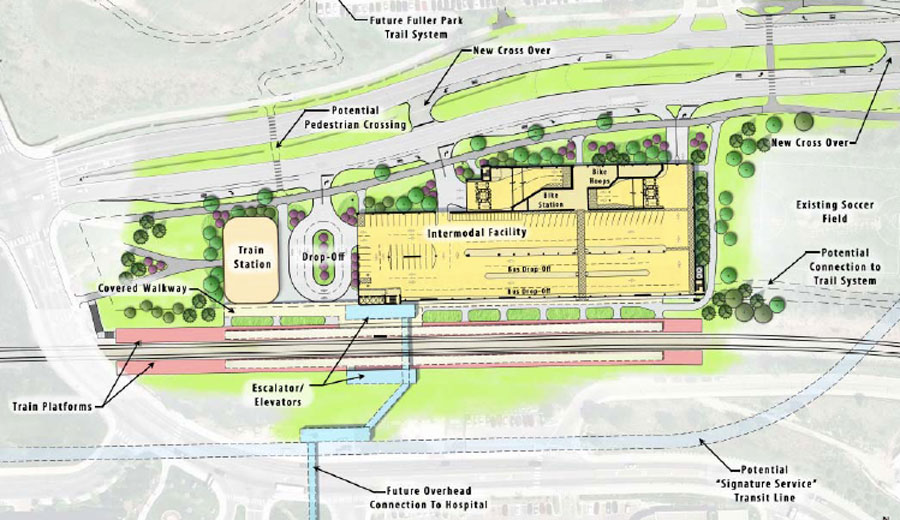
Ann Arbor Station as originally planned, with large University parking structure at right, which will no longer be included in that form. (From the Ann Arbor Chronicle)
The rail station study was approved by an even larger margin: 82%. This despite the high level of opposition from parks supporters, including the Sierra Club's Huron Valley Chapter (of which I'm a member...). Not all environmental choices offer clear black-and-white (or is it black-and-green?) options. The issue here is whether a designated park area can or should be converted into a facility for green transportation. I'd like to briefly recap the issues here, from my perspective, of course...
  1. Is it OK to take this particular land out of "park" designation? Yes, because:
    1. It was traded for another area that remains in its natural state to this day. When the Veterans Hospital was expanding a number of years ago, they intended to use land adjacent to their facility (about a mile east) as a parking lot. This land was wooded, and reportedly included several trees more than a hundred years old. In order to preserve that woodland, Ann Arbor City Council swapped parkland designation with the land now in question, and made a deal with the VA that allowed it to build a parking structure instead, saving the trees. (I have a copy of the Memorandum of Understanding.)
      Result: the land in question has been used legitimately as a parking lot since then, as its parkland designation was transferred.
    2. There is a great deal of beautiful parkland in active use in the immediate vicinity. In addition to the city's Fuller Park, directly across the road, there is Island Park, across the Huron from Fuller Park; and the University of Michigan's huge (123 acre) Nichols Arboretum, immediately to the east. There is no danger that the environs of the station will become any kind or "urban jungle".
  2. Are there no better alternative locations for the station? No:
    1. The current Amtrak station is the busiest in Michigan, in terms of passenger boardings. It's a small, dingy building in the shadow of the Broadway Bridge, unable to expand due to land constrains. It's also an awkward distance from any significant centers of employment or interest. I've walked from it to campus many times, and it's not a walk I'd recommend to anyone not it good physical shape. I'm by no in "great" shape - just "good enough" to make it up the steep hill with my backpack and rolling suitcase, as long as I can puff and pant all I need to.
    2. Several studies have been made to see if the station could expand in its current location. Each of them came up with a firm "no". (Clark Charnetzky is the expert on this, having taken an active part in more than one such study on behalf of the Michigan Association of Railroad Passengers and the disabled community.)
    3. In the Wake Up Washtenaw White Paper, I proposed locating the station at the place where Amtrak crosses under the Ann Arbor Railroad. Though I still feel that site has a number of advantages, I admit that the proposed location - at least for now - is better for the following reason...
    4. The University of Michigan Medical Center is the largest and fastest-growing employer in Washtenaw County. It really makes sense to have a station within easy walking distance of its central facility - and the proposed location certainly is. Any other location would require the use of multiple buses to move employees to and from the station. Buses are good, but walking is better!
    5. The proposed location is also on the most likely route for the "North-South Connector" - the heavy-duty transportation line being studied to connect Ann Arbor's north side with the University of Michigan's central campus and downtown Ann Arbor. It's a no-brainer to locate the regional and (possibly) commuter station on a heavy-duty transit corridor.
It's interesting to note that the proposed station has had its location removed from the name. It's no longer being called the "Fuller Road Station" - simply the "New Ann Arbor Station". Is this in response to opposition to that specific location?

OK. Enough for now!
To learn more:

Wednesday, May 30, 2012

Passengers are Kings of the Rails


In my last post, I wrote about Germany's "love affair" with the private automobile. Today, I'm looking at the inter-city rail system.

There's a lot of freight hauled by rail, but on German rails passengers are the kings. During the daytime when I've traveled, freight trains appeared to be outnumbered about 20:1 by passenger trains. The freights I see are mainly container-trains - short by U.S. standards, at about 40-50 cars. I've seen plenty of bulk freight cars waiting in the yards, so I suppose they must move mainly at night, when passenger traffic is less frequent.

Piggy-back service is offered, but it's a bit different than in North America. Tractors as well as trailers are carried, and trains include one or two coaches so the drivers can accompany their rigs.

Most rail lines are owned by Deutche Bahn (DB), the government railway company. DB operates its own freight trains, but several other operators move freight around Germany and through it to points near and far.

However, there's no question of who has the right-of-way on Germany tracks: it's the passenger trains.

At the top of the passenger "pecking order" are the Inter City Express (ICE) trains. These are white with a red stripe and operate using Siemens equipment allowed to run up to 320 km/h (about 200 MPH). They actually spend much of their time operating in the 100-125 MPH range, since not all track is designed for super-high speeds. At any speed though, they're quiet and smooth-running. The densely-traveled long-distance lines have new track designed for true high-speed operation, including lots of tunnels and viaducts to provide straight, level operation.

One level down from the ICEs are the Inter City (IC) trains. They are operated with electric locomotives and older (but still comfortable) coaches, at speeds up to about 125 MPH. Like the ICEs, they all have on-board snack bars or dining cars and choice of first or second class seats. First class seats are wider, 2+1 across; second class is 2+2; I never saw 3+2, as is common in Japanese high-speed trains and on commuter lines in the US northeast.

Regional service is provided in all areas, including several speed options from express, through semi-express, to all-stops locals. These are usually red with white trim, second-class only, and many are locomotive-hauled with bi-level coaches and can operate up to the 125 MPH range but usually slower, and without food service. Single-level coaches and electric multiple-units are also used for this. There is a dense network of regional rail connections, available between just about all neighboring cities and towns, with stops at intermediate suburbs. These provide commuter service as well as frequent mid-day and evening runs under the "DB Regio" trade name.

Suburban and rural service is provided as "S-Bahn" (suburban line). Under this designation you find both trains and light-rail vehicles. Some of the longer runs are locomotive-hauled, but most of the trains are EMU or DMU sets, everything from single cars to ten-car trains. They are operated by DB, by regional transit authorities, and even by private companies. All offer fairly frequent runs (more often during rush hour, of course) in second-class only.

Commuter and regional locals often have tracks in the mainline right-of-way, but designated for local service only. Express trains then run on separate tracks, which has the advantage of keeping fast through-trains away from station platforms. Light-rail S-Bahn vehicles embody the interurban tradition that died out in the 1930s in North America. In cities, they operate on the streets along with cars, trucks, and buses, on the same rails as city streetcars.

A wonderful example of this is the S-41 line that I took to get to my cousin's house in the village of Bad Rotenfels ("Redrock Baths"), in the southwestern state of Baden-Würtemburg. When I de-trained from the ICE in the city of Karlsruhe, I walked out of the main station across a plaza with three low-level platforms for boarding buses and rail cars. The S-41 rolled down the street in a few minutes - an articulated tram car - and I climbed aboard with women, men, and school kids. At a stop in an enclosed station a couple of blocks away, our car bumped into another waiting car, coupling on, and the driver got out and left. With the first car in charge, we soon left and headed south along the rail line at a top speed of about 55 MPH, stopping at all the little stations along the way. Each station was announced by a pleasant, recorded woman's voice and electronic sign. In that bucolic setting, I was rather surprised to see a French TGV breeze past in the other direction. At Rastatt, however, about 15 miles south of Karlsruhe, we left the main track and wound up a line that felt very much like an interurban trolley's: sometimes double-track, often single; passing through fields, trees, and stopping at villages. One of these villages is Bad Rotenfels, where my Krieg ancestors had lived beginning in 1797, making farm wagons, carriages, and related wheeled devices. The S-41 continues south for 32 miles to Freudenstadt, winding through the lovely narrow valley of the Murg river.

Continuing my tour of Germany a few days later, I boarded a morning interurban run and found standing-room only as far as Rastatt, after which I got a seat - and some video out the back window.

Clearly, the German idea of freedom is embodied in their fast cars, good roads, smooth rails, and abundant trains. How do they pay for this freedom, and what effect does it have on their community environment? This will be the subject for future posts.

Monday, May 28, 2012

The Land where Freeways First Blossomed


Yes, Germany, not the U.S., was the first place where the freeway concept was implemented on a large scale. Without going into extensive detail on the history of freeways, suffice it to say that in the 1930s the National Socialist (Nazi) government implemented the idea of limited access multi-lane highways, with no legal speed limit. By 1940, more than 2,300 miles had been built. (At the same time, diesel and steam-driven high speed rail technologies were developed.)
World War Two destroyed much of Germany's transportation infrastructure, but with the Marshall Plan, highways and railways were rebuilt and Germany prospered. Companies like Daimler-Benz, Bayrishes Motor Werke (BMW), Audi, and Volkswagen produced automobiles that became highly desired around the world, including at home in Germany. Many people use them for the purpose they were designed for: to travel at high speeds on the well-maintained Autobahns (and also on more challenging country roads). They provide convenient transportation as well as exciting entertainment for those who enjoy it. German cars are designed for high speed, and German drivers are relatively safe and skilled: according to IRTAD, in 2008, there were 2.2 road user fatalities per billion vehicle kilometers. (The comparable figure for the United States is 4.5 fatalities per billion kilometers.)
On the way from the airport to my hotel for the first night, the shuttle-bus took the autobahn for a couple of miles, traveling at a respectable 60-70 MPH. At first it was a bit of a shock when a car passed us in the left lane, apparently going twice as fast. It happened several times.
Later, riding with my cousin, I wasn't surprised that he was driving at about 110 MPH on the autobahn. What was somewhat interesting was doing it in his 12-year-old Ford Escort...and living to tell the tale. I suspect he may have imagined his Escort to be a Beamer in disguise. He is clearly accustomed to driving that way, and does it with skill and precision, even in a car clearly not intended for that type of driving.
Of course, it's not just the active men who drive - and love - their car. Discussing this with 30-something friend, a business woman, I got the impression that cars are seen as a really valuable supplement to public transportation. She uses the tram and subway on a daily basis to get around the city in Düsseldorf, but for grocery shopping and visits to her family in a neighboring town, she prefers to use her car. Living in a moderately dense part of the city, she has to pay extra for a parking spot, but the expense is worth it for her.
Bottom line: Germans love their cars and their good roads. They keep building more, too: we drove through several on-going autobahn widening projects, and as I write this (in a train!) we just crossed over what appears to be a totally new autobahn under construction.
At the same time, Germany has one of the finest public transportation systems in the world. Clearly they've found a way to have the best of both. Hmmm...can we do it in the U.S.?

Thursday, May 24, 2012

Mobility and Community in Germany

I'm spending a week in Germany, partly to do family research, partly to see friends, art, and culture; but also of course to observe the interaction of mobility and community here.

Many people who have been to Germany have commented to me that "of course" the public transportation here - especially rail - is great. Sometimes these comments are accompanied by a rueful sigh and a shake of the head, as if to say, "naturally, we'll never be able to do anything like this in the U.S."

Like Americans, German people are highly mobile. They love to travel, both within Germany and abroad. Their economy is prosperous, and many of them choose travel as a way to use their discretionary income. Most Germans are hard-working, well educated, and take an interest in world events. Mobility is a highly prized right for them, as it is for us Americans.

But land is very expensive everywhere: even in little Bad Rotenfels, the town where my German ancestors lived, I was informed that one square meter goes for about €400, which works out to more than $2 million per acre. As you can imagine, this has a profound effect on people's mobility choices: driving downtown and parking is an option one has to consider very carefully. And it also explains why so many Germans came to America in the 19th century: as their families grew, most couldn't afford to buy land for expansion.

So for the next few days I'll be blogging about how mobility impacts community in Germany. Stay tuned!

Monday, May 7, 2012

Some Perspective on Transportation Costs

A recent article in AnnArbor.com discussed recommendations from the Countywide Transit Financial Advisory Committee. I had already had the opportunity to check out the complete plan; what struck me about the article was the overwhelmingly negative tone of the comments. After all, most people who gave citizen input about the possible county-wide plans voted for the "smart growth" plan, which was clearly the most costly of the three options presented.

Of course, I realize that people who oppose something are much more likely to speak out than those that support it. And I know that any suggestion of raising taxes is an especially productive way to invite negative comments.

That's what I want to put into perspective. The Financial Advisory Committee suggested a half-mil tax. That works out under Michigan law to be $50 on a house valued at $200,000; which is pretty close to the average of the county's home prices.

My biggest objection to those who rant about taxes for transportation is how it compares with the cost of fuel for automobiles. As I've pointed out before in this blog, the great majority of the money we pay for our gasoline leaves Michigan to enrich others, including the governments of nations that are hostile to us. (More on this in a moment.)

We can't do anything about the cost of gasoline, which is controlled almost entirely by oil speculators for their own profit. On the other hand, most of what we pay for transit stays in the United States, especially in Michigan. (Yes, some does go out of the country to pay for diesel, but remember: AATA uses domestic biodiesel along with diesel from mineral sources.) All the buses are made in the USA, and all the personnel costs stay right here in Southeast Michigan.

But, the critics say, I don't care where the money goes to, I'm talking about where it comes from: my bank account! So here's a little reality check to illustrate how out-of-proportion the objections are...

A 2012 Ford Explorer (the popular mid-size SUV) has an 18.2 gallon tank. Gas has been running about $3.799 per gallon as I write this. That means each complete fill-up of the Explorer's tank costs $69.14. Of course, you won't fill the entire tank unless you totally run out of gas, but you'll easily put in $50 every week (that's just over 13 gallons) if you use the vehicle to commute and/or take kids to school and after-school activities. That's as much as most people will pay in an entire year to make transit more convenient in Washtenaw County.

Of course, that's only half the "reality check". The other half is what - if anything - most people would actually save. Most people won't be able to reduce their car use much, but suppose they're able to let a kid ride the bus to a practice, and possibly take the bus to work once a week. Even saving one gallon a week, at $3.799 (assuming the price doesn't go up - ha!) would amount to $50 in just over three months.

As a business decision, that would make a lot of sense, because a three-month payback period is really good, and the investment ($50) is pretty darn small.

Yes there would be quite a few people who would pay more than $50, and who would probably be reluctant to use their car less, even if transit were more convenient. So why would they vote for this? Maybe because it would save their city from investing even more money to build downtown parking? Maybe because they're able to think far enough ahead to see that our sprawl growth pattern isn't the best for the long term?

The only drawback is that a half-mill won't really get the improvements going very quickly. I'd recommend a heftier millage to build up the transit network sooner - a full mil, $100 per year on average, really isn't all that much for the value the community would receive. It could still only take six months for most people to break even on the investment!

I know there are some folks whose distrust of government is so deep that they would rather pay for anything than pay tax to their government. But you see, when you buy gasoline, you're sending money to several governments. In the blog post "National Deficits: Government and Oil" (linked below), I calculated that 57% of our gasoline money goes to friendly foreign countries and allies, but 6.4% goes to governments that are actually hostile to us.

How does that compare with the proposed millage on a yearly basis? Well, the average car is driven 11,489 miles yearly according to the Federal Highway Administration, and the average fuel consumption was 23.8 MPG. Doing the math gives us a ballpark yearly average of $1,834 for each car's fuel, meaning that we send about $1038 to other countries every year, including $117 to countries that don't like us.

And we can't do anything about it: we can't vote the rulers of those countries out of office, nor can we we pick and choose where our gasoline comes from. So it's not a question of refusing to pay more taxes: we're already stuck paying money into the treasuries of several foreign nations.

But (and here's my point): the more we improve our transit system at home, the less we'll be forced to pay foreign countries for our fuel.

I'm actually pretty confident that most Washtenaw County voters will see the value of improved transit, and will be willing to pay for it.