Friday, October 23, 2009

Left Behind

Michigan is getting left behind. No, it's hardly the "rapture". As our state writhes in the grip of legislators who refuse to allow investment in our people or our infrastructure, population drops and industries leave. Planning Commission meetings in Ypsi Township are cancelled because there's practically no new development, and scant money to pay the commissioners for their time.

http://allsystemsgo.capmetro.org/images/Capital%20MetroRail%20Red%20Line.jpgThe economy is bad. But it's not like that all over the country. I subscribe to Rail magazine, ("Connecting Communities by Moving People") whose current issue features articles on five regions that have recently inaugurated new rail service. All are very much like what Wake Up Washtenaw has been proposing for the rail line north and south of Ann Arbor: (1) use a freight rail line that sees little freight traffic or has been abandoned, and (2) use diesel multiple-unit cars (DMUs). These paragraphs really jumped out at me in the article about Austin, Texas's, new MetroRail:

Leander Takes the Lead

Leander Mayor John Cowman is an enthusiastic proponent of Capital Metro's Red Line and of regional rail in general. He credits passenger rail with fundamentally changing the image - and future - of Leander (pronounced Lee-ann-duhr [li 'æn dr]).

"Our sleepy little hamlet, which many regarded as the laughing stock of the Austin region, [nothing like Ypsilanti, of course! - LK] has been awakened and rail is a key component in that change," says Mayor Cowman.

Indeed, the changes around Leander in the past decade have been significant. Since Cowman was first elected in 2003, the population of Leander has jumped from 12,000 to more than 30,000. [Probably half of them from Mexico and half from Michigan. - LK]

Today, significant transit-oriented development is underway in the town and the local economy has seen the arrival of several new employers. [Mostly relocating from Michigan? - LK] In 2005, Leander adopted a 23,000 acre transit-oriented development community plan that encourages more dense development as well as improved pedestrian and biking right-of-ways. [23,000 acres? WOW!!!]

"Recently, a manufacturing firm located itself here in Leander," says Cowman. "This brings hundreds of new jobs along with it, and the first words out of their mouth about why they selected Leander was, 'access to public transit.'"

For mayor Cowman and many residents of Leander, the approach of the Red Line is more than just a passenger rail link to Austin, it is an affirmation of the community's dedicated sales [...] tax to Capital Metro and [its] vote in 2004.

"We're energized by the train, we've been anticipating the day it starts serving Leander for a good while and it gives us a feeling that we did the right thing," says Cowman. "And since that vote, so many issues have cropped up like the economy and fuel prices that the train will help us manage."

http://impactnews.com/images/stories/RPF/2009/05/32-railphoto.jpgBut of course, nothing like this could happen here in Michigan, right? We're too dedicated to being left behind. No sense investing our dollars in a sinking state. *Sigh*


Sunday, September 20, 2009

Courage in Government

We don't normally think about "courage" in our local government leaders and "bureaucrats". A few US presidents (not many!) have earned respect as courageous leaders, but it does take courage to make decisions that may be unpopular even at the local level. I saw a movie (Amazing Grace, 2006) about William Wilberforce a couple of weeks ago. He was the English Member of Parliament who almost single-handedly led his country to abolish the slave trade in 1807, half a century before we did in the US. It took Wilberforce several decades of frustration, ridicule, and threats to overcome the resistance of powerful merchants who had made their fortunes on the suffering of Africans. the argument then, as now, is that it was bound to hurt business and cause unemployment. England was the first country in the world to outlaw slavery, and I highly recommend seeing Amazing Grace to learn what it took.

A couple of examples of courageous government decision-makers have come to light recently. Nothing as earth-shaking as the abolition of the slave trade, but little decisions that can have long-term consequences for all of us.

Ypsilanti Mayor Paul Schreiber

Last Tuesday evening, September 15, Ypsilanti City Council was faced with the tough decision of what to do about AATA service. You may recall that residents of the City of Ann Arbor pay their full share of AATA service, but residents of the other jurisdictions where AATA runs pay only part of their share. The rest is picked up by federal grants, organizations like U of M that subsidize their staff and students' transit use, and ...residents of the City of Ann Arbor. Having encountered objections to this arrangement from Ann Arbor, the AATA Board of Directors decided to ask the other jurisdictions to pay more, gradually increasing over a 3 year period until they are paying their share. Then the recession hit.

The outcome (so far) for Ypsilanti is a Council resolution asking AATA to reduce service to a level the city can pay. The resolution asks AATA to eliminate the Ypsilanti portion of Route 5, Packard Road, and cut back the last night run on Route 10, Northeast, and Route 11, Southeast.

At first glance, the impact might seem minimal. After all, by the time Route 5 enters the city of Ypsilanti on Cross Street, it is running only two blocks from Washtenaw Avenue, where Route 4 runs every half hour, and six blocks from S. Congress Street, where Route 6 runs every hour. Why can't transit-users walk the extra two blocks to Washtenaw, or perhaps a little further to Congress? Maybe they could, but eliminating Route 5 makes it much harder for Ypsi residents to reach the parts of Ann Arbor served by Route 5, but not by Routes 4 or 6. I believe the issue is much the same as with the elimination of access to Arborland: at a time when more transit service is needed for economic and environmental reasons, it is being eroded.

The same is true of eliminating the last runs of Routes 10 and 11. The east side of Ypsilanti is already underserved by these two routes, which run only once every hour and only in one direction, using circular routes that discourage and confuse potential riders. I've already mentioned in this blog the need for much better service to the East Michigan Avenue corridor, and here we are cutting it back. East Michigan is a place where there is considerable night-life, so cutting the last bus of the night has the potential to hurt business there. (OK, so maybe the business there is not the most upstanding. But cutting bus service certainly won't help that.)

Ypsilanti City Council's resolution also called for use of Federal (stimulus) funds to cover the remaining shortfall. A one-year solution at best. It's always easier to ask someone else to pay for what you want, isn't it?

And what of Mayor Schreiber? He cast the lone vote against the resolution, saying bus service is a high priority for many reasons (according to WEMU and AnnArbor.com). Now, that took moral courage. Ypsilanti would have to come up with funds to pay for the service, and very few people in public office are willing to stand up for anything that will cost more money, even if it will save them money in the long run, as transit does. I'll come back to this shortly.

WATS Executive Director Terri Blackmore

The second courageous action was a decision made by the WATS Policy Committee, specifically the WATS Executive Director and the staff. If you've followed this blog for a while, you may recall reading about the Washtenaw Area Transportation Study, the county-level authority for allocating transportation funding. One of the big tasks WATS faces is the revision every five years of a 25-year transportation plan for the county. It's the result of analyzing all the county's transportation needs and dividing up available and anticipated funds for different types of projects. The new 25-year plan was finalized at Wednesday's WATS Policy Committee meeting (September 16).

To understand the situation, here is a look at the planned allocations. These two pie charts show the percentages recommended for different types of projects five years ago (in the 2030 plan) and now (the 2035 plan):

Here's a table comparing the allocations.

Improvement Type
2030
2035
Cost (000’s)
Bridge
16.4%
6.8%
$68,743
Capacity and New Road
13.7%
12.4%
$126,685
Intersection
6.9%
0.9%
$8,851
Studies and Miscellaneous
6.9%
0.3%
$2,671
Resurface/Reconstruct
39.6%
42.7%
$432,874
Non-motorized
3.4%
2.8%
$28,154
Safety
1.1%
0.7%
$6,941
Signal
5.1%
0.3%
$1,292
Transit Capital
6.9%
33.3%
$337,020
 
100.0%
100.2%
$1,013,231

It's the Transit Capital that I'd like to draw your attention to, of course. Such a massive leap in percentage allocation! Naturally, Wake Up Washtenaw is in favor of this increase because we believe if shows an understanding of the true needs of the future, and it takes courage to put that into numbers. To make that increase, it was necessary to reduce the percentages recommended for bridges, capacity, new roads, intersections, traffic studies, non-motorized transportation, safety, and signals. There are a lot of people likely to be dismayed by each of those reductions - I'll come back to that in a moment.

First, a couple of notes: most important, the cost estimates don't represent existing money. They represent needs, and a reasonable estimate of what we should expect to pay. Coming up with real money is another challenge. Also, the Safety category wasn't listed in the 2030 plan, but the total in that plan added up to only 98.9%. It's just my guess that the missing 1.1% (in gray) was allocated to that category.

The Courage of their Convictions

Both Blackmore and Schreiber are to be commended for standing up and allowing themselves to be counted in potentially unpopular decisions. If you're a transit supporter, or an environmentalist, or a "smart growth" advocate, you may wonder why anyone would question these two decisions. Well, there are plenty of people who would:

  • Small-government people, whose position was well articulated by a friend of mine: the role of government is to legislate and regulate, not to provide services - that should be left to private business. They're not necessarily even the "tea party" shouters. The problem is, there are services that are necessary to community well-being which can't necessarily make money on their own; transportation is a prime example. These people usually insist that government does everything inefficiently, holding up one or two examples and ignoring the many recent cases where private business has cost us more money than anything else.
  • The folks who want to let somebody else pay. These are the people who want all the benefits of civilization without paying for it. They're the ones who vote against any and all taxes, and then complain loudly when their cul-de-sac isn't plowed by the County immediately after each snowfall.
  • Car-worshippers: "You'll have to pry my cold, dead hands off my steering wheel before I'll give up driving, so why should I subsidize someone else's public transit ride?"
  • The complacent: whether because they're comfortable now, or because they don't believe there's a storm over the horizon, they just think things will continue indefinitely the way they are now.
  • Those who believe public transit is the wrong answer: many people believe transit is simply too expensive and underutilized because of the spread-out nature of our cities and suburbs. They're right as far as that goes, but don't see one step further: that we're spread out because of publicly-funded roads that made it cheap to spread out - for a while.
  • Most elected officials: unwilling to risk voting for anything that might jeopardize their re-election or campaign contributions, no matter how necessary the measure may be.
  • The highway/developer/real estate lobby: the many businesses that make (or made) a good living from the automobile-based economy, and you may be sure that even now they have enough money to mount a powerful campaign against anything they believe will threaten them.

With all these groups opposing spending more for public transit, it takes courage to stand up and insist that we find the money for it. According to the September, 2009, calculations, riding public transit saves individuals $9,147 annually, but even a fraction of that to pay for transit would be opposed by most of the groups I just mentioned. In the future, citizens looking back will wonder why doing the right thing was so hard, just as we do when we look back at William Wilberforce's effort to abolish the slave trade. (If you're not sure why transit is "the right thing", take a look at the June 9 blog, which recaps the advantages.)

And of course, a hearty Thanks! and Well Done! to Paul Schreiber, Terri Blackmore, and the staff at WATS: Ryan Buck, Eric Bombery, and Nick Sapkiewicz!

Friday, July 10, 2009

Highball for HyRail?

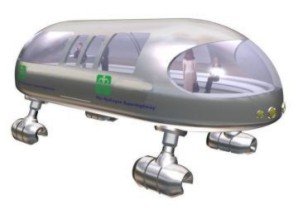
It's gone under several names: HyRail, Hydrogen Superhighway, and Interstate Traveler. It's been accused of being "sci-fi". It's a transportation system, it produces and distributes electricity and hydrogen fuel. It won't cost the government a penny, but it will provide millions of jobs. It's the brainchild of Justin Sutton. Unfortunately, it's still a dream.


What is it really? In a nutshell:

  • Transportation: maglev vehicles of various sizes will travel along pairs of rails containing superconducting magnets
  • Energy: a central conduit covered with solar panels will generate power to move the vehicles, while extra power will be converted to hydrogen using electrolysis; the hydrogen will be used to generate electricity to run the system during the dark hours, so it will be entirely self-powering
  • Distribution: pipes in the conduit will carry water for electrolysis, hydrogen to storage, fiber optic cables for communication, and large amounts of electricity using the supercooled pipes needed for magnetic levitation
  • Where: along existing rights of way - highways or railways; the tracks are elevated maybe 15-30 feet above the ground
  • Financing: Revenue is expected from generating and distributing energy as well as from farebox, and will be shared 50/50 with right of way owners; the economic model looks very promising
  • Environment: produces zero greenhouse gasses, and being elevated, has a very small footprint on the ground
  • Vehicles: can be made by any company that meets the ISO specifications now being drafted
  • Speed: the goal is to top out at about 180 MPH.
  • Manufacturing: could be anywhere, but Interstate Traveler LLC is based in Michigan, so Justin says they'll be starting in Michigan.

What's not to like about this plan? Absolutely nothing, the way Justin tells it. Several Michigan legislators are supportive; State Senator Valde Garcia (R-Livingston) and State Reps Bill Rogers (R-Livingston/Oakland) and Mike Huckleberry (D-Montcalm/Ionia) held a hearing on the energy implications of the system this morning at the University of Michigan. All were positive about the proposal. Politically, it's a sure win: no tax money to be allocated, but possible revenue and jobs to be gained.

I was skeptical when I went to the hearing, and remain skeptical after attending. Not opposed in any way. It all sounds so good, I just have to ask, is it too good to be true? The concepts are great. The math seems solid, both the physics and the finances. The assumptions appear conservative. The graphics are cool.

But there are no prototypes. Nothing has been tested against reality. Computer models are fine, but they're talking about lots of stuff that has never been put together before. Solar panels are reliable; hydrolysis has been used a long time to make hydrogen; superconducting magnetic levitation is in commercial - but limited - use; elevated guideways have been used reliably in many places. But these technologies have never been put together, and never on this scale. There are no working models or prototypes of the proposal, not even a quarter kilometer of track has been built, let alone tested.

So a lot of up-front work still has to be done before this will rise to a confidence-level that will attract private funds. Justin is avoiding public funds, even for R&D. More power to him! But can he attract funds from cautious private investors without anything more than cool pictures and computer models? That's the big question now.

Good luck, Justin!

Check out the company's Web site for yourself. What do you think?

Friday, July 3, 2009

Creative Environmental Stewardship

This ought to get a prize for creatively using unlikely combinations of elements to benefit the environment:

Elephants and Sweet Potatoes to Feed Osaka's Closed-Loop Project to Mitigate Heat Island Effects

The mayor of Osaka, Kunio Hiramatsu, announced on February 18, 2009, that the city will carry out a closed-loop project using sweet potatoes and elephants in fiscal 2009. To mitigate the urban heat island effect in summer, the city aims to green the rooftop of City Hall with sweet potato plants and use the plant vines and leaves that are usually disposed of for feeding elephants in Tennoji zoo. The elephant's dung is then used as fertilizer to grow sweet potatoes.

http://www.japanfs.org/en/pages/029073.html

This is from Japan for Sustainability, whose Web site and newsletter note lots of other creative solutions to ecological issues. I recommend it!

Monday, June 22, 2009

Wally inches forward; Arborland shuts out AATA

There's good news and bad news. For every step forward we take at least one step back. First, the good news.

Wally Inches Forward

Wally, the proposed commuter rail line from Howell to Ann Arbor, is coming slowly closer to reality. Today's coalition meeting noted these steps forward:

  • An archeological investigation was conducted at the proposed Hamburg station site to insure than no Native American grave sites or artifacts would be desecrated. That was necessary because it's within a mile of a known Native American burial ground. The only artifacts found were two nails and a bolt, less than fifty years old, so the Hamburg station has the go-ahead.
  • The plan calls for using bi-level commuter rail cars sold by Chicago's Metra agency when then got too old to be worth keeping. After a competitive bidding process, a contract has been awarded to Great Lakes Central Railway to refurbish the cars and make some of them ADA compliant. The idea is to assemble the cars into sets that will each include at least one car with a wider door and space for wheel chairs.
  • The boarding-platform height has been determined: 8 inches over the top of the rail. This will allow plans for stations to be started.
  • Surveys are in progress to determine what people want and how they feel: the phone survey for Livingston County areas near Wally was completed last week; the one for Washtenaw Wally areas is this week. An on-line survey of interested people will be available soon. I'll send you the link when it's up.
  • The PR consultant suggested a unified approach to getting information out - especially the reasons we need Wally. It involves two co-chairs, one from each county through which Wally will pass (Washtenaw and Livingston). There was a long discussion of how that effort would be organized, the upshot of which is that nothing has been decided yet.

Arborland Ejects AATA

If you live in the area, you've probably heard by now: Arborland's management is shutting out buses beginning July 1. AATA has used Arborland as a transfer point for thirty years. I remember riding to WCC when I first started teaching there in 1983, transferring at Arborland. Routes 4, 7, and 22 call there, and AATA counts about a thousand boardings there every weekday.

Apparently AATA has been in negotiations with Finsilver Friedman, Arborland's owners, off and on for a couple of years. A significant number of passengers are known to park in Arborland's convenient lot, hop on a bus, and retrieve their cars several hours later without spending a dime at the mall. Store owners - reasonably enough - objected to parking spots being taken in that way, so AATA posted signs to direct bus users to use only spots away from the stores. They even offered to put AATA staff at Arborland to shoo passengers away from parking in places too close to the shops. Finsilver Friedman simply refused to renew. AATA has explained it in a press release on their Web site.

Let's be clear: Finsilver Friedman has every right to restrict their parking lot to paying customers, and AATA is not a paying customer. That said, it's a stupid move. Really dumb. Rumor has it their email inbox is over quota from all the complaints they're getting. They're not answering any of them. They won't say why they're refusing AATA's permission in spite of efforts to accommodate the mall's needs. My private theory about their reticence is that they don't like the kind of people who are supposed to ride buses. They want Arborland to be seen as an upscale kind of place, but "everybody knows transit riders aren't the right kind of people." Articulating that would leave them wide open for accusations of stereotyping, prejudice, and even *gasp* racism, so silence is golden.

With more and more people flocking to public transit, you'd think mall management companies would welcome buses. You'd think they would consider ways to integrate bus-riding and shopping. Perhaps bringing the buses closer to the shops, rather than keeping them at arm's length on a concrete island surrounded by parking lots and driveways. Maybe even putting stores like Hiller's and cafés like Starbucks right next to the bus transfer points, so people could easily pick up a latte or a gallon of milk while waiting for their bus.

Instead, the buses will be stopping in traffic on Washtenaw Avenue, at least for now. Most people wanting to transfer will have to cross Washtenaw at one of its busiest points. AATA is urging people to cross at the Yost signal (here's the diagram). But the arrangement of the intersection is maximally inconvenient for that. Let's say you're on a 4 or 7 bus heading toward Ann Arbor, and you need to get to North Campus or the VA Hospital. For many years, it was just a question of getting off your first bus, waiting for the 22, and getting on. Beginning July 1, You'll have to get off, wait for the light to cross the west Arborland drive, wait again to cross Washtenaw, and wait again to cross Yost before boarding. Tell me nobody will try to dart through traffic on Washtenaw, especially if they see the 22 about to leave. Tell me everybody will wait for three changes of the traffic signal, even if it means missing their bus and waiting another half-hour in the rain.

AATA has been in touch with MDOT to try to remedy the situation. Washtenaw is a State Highway, so MDOT has to approve any changes. You may have noticed that MDOT's budget is disappearing fast, and AATA's revenues are shrinking rapidly, so tell me how long you think it will take to get funding to make any changes.

There may be a bright spot, though. With those nasty buses gone, and plenty of parking available for upscale customers, Arborland's revenues will be going up, right? So the City of Ann Arbor will benefit from a huge increase in tax revenues, won't they?

What to you think?

Wednesday, June 10, 2009

Transit Oriented Development's Advantages

OK, maybe it doesn't seem cool to blog about someone else's blog, but this is one that's really worth it. It's Todd Litman's blog on Planetizen, "Comprehensive Evaluation of Transit Oriented Development Benefits." Todd is the executive director of the Victoria Transport Policy Institute, in Victoria, British Columbia, Canada.

One interesting fact that came to light in his study is that TOD increased transit use somewhat, but most of all increased walking, and decreased vehicle miles traveled (VMT, the standard measure of automobile use).

Let me give you a quote of the main TOD advantages he cites, then urge you to read the entire blog entry:

  • Congestion reduction (30-50% reductions in per capita annual congestion delay are typical between transit-oriented cities and comparable size automobile-oriented cities).
  • Road and parking facility cost savings (worth hundreds of dollars annually per capita).
  • Consumer savings and improved affordability (often totaling thousands of dollars annual per household).
  • Improved safety (residents of transit-oriented communities have about a quarter of the per-capita traffic fatality rate as residents of automobile-dependent sprawl, taking into account all traffic deaths, including pedestrians and transit passengers).
  • Improved mobility options for non-drivers (non-drivers benefit not only from improved public transit service, but also from improved walking and cycling conditions and more compact and mixed land use).
  • Improved public fitness and health (transit users are four times as likely to achieve the target of 20 minutes or more of walking per day as people who do not use transit on a particular day).
  • Increased local property values and household wealth (improved accessibility and transportation cost savings tend to be capitalized in higher land values, which appreciates over time).
  • Energy conservation and emission reductions (residents of transit-oriented communities tend to consume 20-40% less transportation energy than they would in more automobile dependent communities).
  • More dollars circulating in the local economy (expenditures on vehicles and fuel provide less employment and business activity than expenditures on other consumer goods, and much less than expenditures on transit service).

Interesting? So go see what else Todd has to say! http://www.planetizen.com/node/39133